Posts

World War I's Impact on the World of Art

Image
    I have decided to look at three pieces of work that were clearly influenced by the tragedy of World War I. These paintings shook me as I was looking for different pieces from the early modern era. It was heart-wrenching to think about what the artist must have been going through as the images were created. I would like to share my thoughts on the following pieces with whoever reads this post.     The Menin Road Artist: Paul Nash Circa: 1919 Location: Buckinghamshire, England, United Kingdom Image hosted by: https://en.wikipedia.org/     The first thing I could see in this picture was the trees. Shattered and destroyed stumps where tall leafy giants would have stood five years before this painting. As I take a step back I start to see further tales of death and destruction on this stretch of land. The bottom left shows the remains of a bombed-out building buried into the earth and an empty helmet floating on top of the water amidst pitted eart...

My Thought on Impressionism vs. Realism

Image
   I was surprised to see the introduction of so many new styles of art from the romantic period. I had a difficult time deciding which styles to compare because each style has many pieces that I enjoy. Some, for the emotional responses, and others for the techniques displayed. Ultimately, I decided to compare impressionism and realism because of how each style's subjects are portrayed on their canvas. Let me begin by looking at my preferred style, impressionism paintings and following up with two pieces of realism work. Water Lilies and Japanese Bridge  Artist: Claude Monet Circa: 1899 Location: Europe, France, Haute-Normandie, Giverny Image hosted by:   https://commons.wikimedia.org/    When I look at this painting the first thing that I feel is a sense of tranquility wash over me. It encourages me to break away from my electronics and indoor settings and explore the calming atmosphere of nature, such as a park or lakeside. I believe that was one of the r...

Science as a Focal Point in Classicism Art

Image
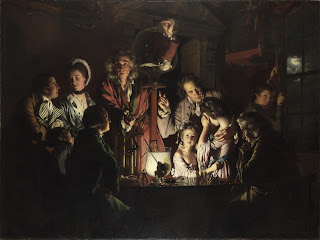
   Scientific discovery flourished during Enlightenment. A worldview of God, reason, nature, and humanity was established. Reason became the driving force of this worldview. Through reason, induction and deduction helped to create a new study of natural sciences. The invention of the encyclopedia further aided scientific discovery by allowing knowledge to be commonplace. Sciences rapidly advanced with the force of reason. This led to new inventions, including tools and even energy.              Alongside these developments, exploration of the world led to the discovery of Pompeii. The horror preserved there reignited interest in antiquity. The art of Rome and Greece began influencing the artwork once again. However, one of the notable changes was rather than idealized forms, flaws of the human subject were allowed to be captured instead.      The pieces I will be looking at show influences of antiquity from cloth...

Beautiful Landscape Painting from the Dutch Golden Age

Image
  Title: View of Haarlem from the Northwest, with the Bleaching Fields in the Foreground Artist: Jacob van Ruisdael Circa: 1650 - 1682  Location: Haarlem, North Holland, Amsterdam Image hosted by: Rijks Museum     I came across this picture from the lecture videos, and I fell in love with it. My favorite aspect of  View of Haarlem from the Northwest, with the Bleaching Fields in the Foreground,  is the composition of the clouds. They appear to be drifting across the sky. This movement creates a beautiful contrast of light and dark on the horizon below. The clouds also play with that same contrast where the bright blue sky is more visible from behind the lighter clouds and then moving to a cluster of gray clouds blocking out the same bright blue sky on the left. Moving from the sky down to the fields and the city in the distance, the clouds have created an interesting pattern of light breaking up the heavy dark tones. As I look upon the fields, my eyes...

Italian Renaissance Architecture

Image
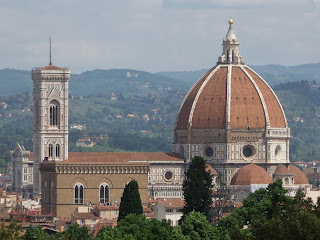
  Dome of Cattedrale di Santa Maria del Fiore Location: Florence, Italy Architect: Filippo Brunelleschi Construction: Between 1420 and 1436 Photo by Belinda Fewings on Unsplash          I have chosen to look at the Dome of the Cathedral of Santa Maria del Fiore and its ties to the Italian Renaissance. The dome of this cathedral was built more than a century after the cathedral's construction had begun. Arnolfo di Cambio was the first architect hired to build this cathedral and the first stone was laid in 1296. Cathedrals such as this were being built due to an idea from the middle ages. Cities in Italy would build cathedrals larger than the previous to compete with another in terms of wealth or standing. This cathedral in particular was built to compete with those built in Pisa (1093) and Siena (1260). While the cathedral may have begun as a contest of sorts from the middle ages, the dome itself is heavily influenced instead, by the Renaissance movement. ...

The Elements of Art at Work

Image
  Title: A Sunday on La Grande Jatte Artist: Georges Seurat Created in France 1884/86  Image hosted by: https://www.artic.edu/        I first came across  A Sunday on La Grande Jatte  in middle school for an art elective. This piece was our brief introduction to the technique of pointillism. I wasn't very interested in this type of art at the time. It wasn't until I saw it again in the movie  Ferris Bueller's Day Off  that I grew curious about that painting. At first, it was a shallow curiosity about a pleasant setting. Now I see a small island on the river Seine at the gates of Paris. I see many different things that I find appealing. First, we had vibrant colors in the background but shaded tones in the foreground. I followed the bright colors to the shaded area, where we have people sitting, lounging, or even standing under the cool canopy. The darker tone of the colors invoked a feeling of tranquility, while the vibrant colors broug...

This is me

Image
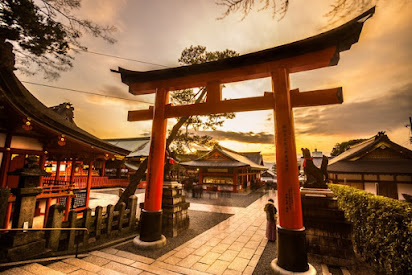
 Image by: Laura. “Fushimi Inari-Taisha Shrine in Kyoto, a Corridor of Red Columns.”   Hello there,   My name is Tim, and I am 36 years old. I recently decided to return to college to finish my degree. I struggled many times throughout my college career, never quite finding a degree program that felt like it fit. Finally, after a couple of years of electives and general ed, I tried studying fine arts from a new media perspective. However, I learned that I didn't have the talent needed to succeed in that field. I was heartbroken and this led to me taking a break from college. After some self-pity followed by some health scares, I was ready to try again. Before jumping in, I thought back over the moments I had enjoyed most in my life. The moments that came to mind surprised me. They were when I was working with kids or listening to or advising my friends and colleagues. With that, my aim has now shifted from art to teaching. I hope I can...